Articles · Anatomy
The muscles you chew with: a simple guide
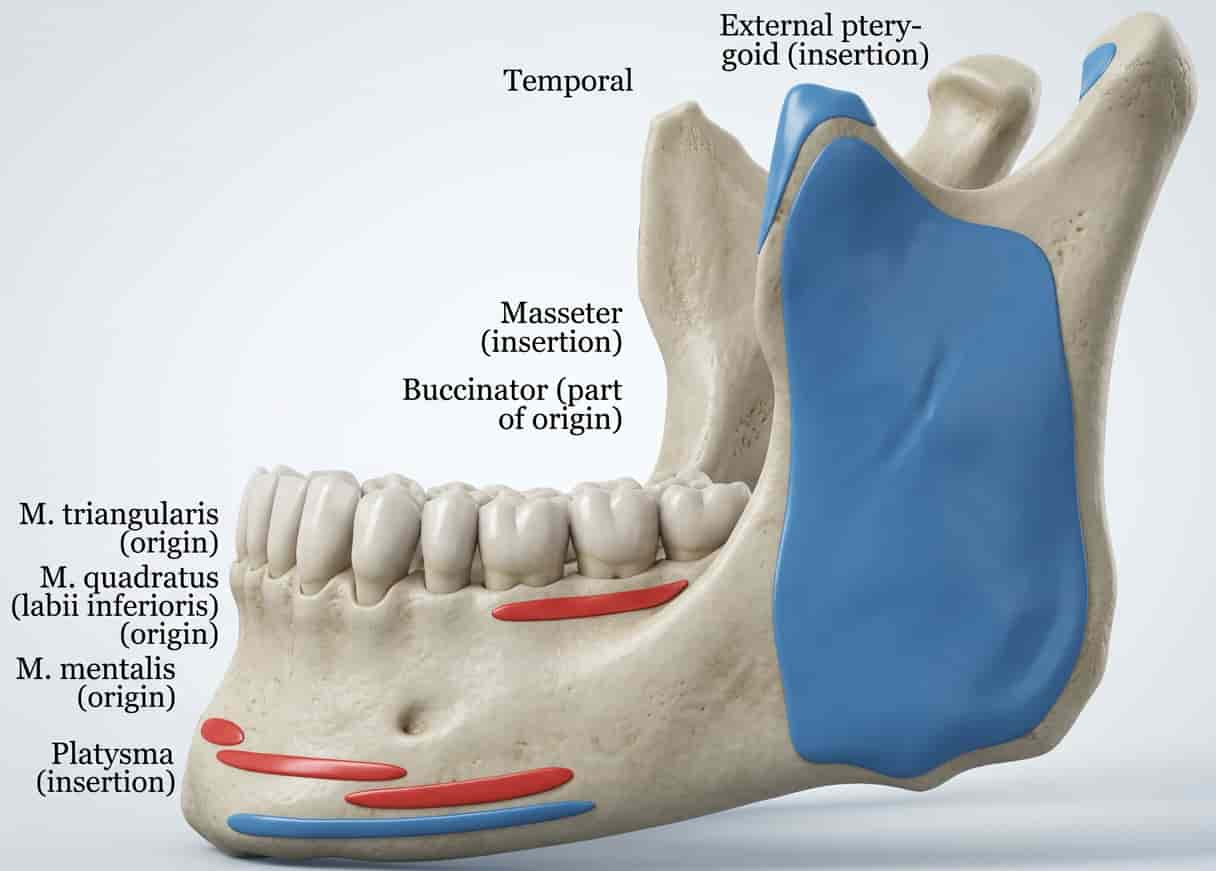
Four pairs of muscles move your lower jaw. Together they're called the muscles of mastication. Knowing what each one does makes it easier to train them well.
1. Masseter: the one you can feel
Put your fingers on your cheek just in front of your ear lobe and clench. The bulge that pops out is the masseter. It runs from your cheekbone (the zygomatic arch) down to the outer surface of the lower jaw near its angle. It has a superficial and a deep part, and its job is to close the jaw with force.
Because it sits right on the outline of the lower face, the masseter is the muscle people mean when they talk about jaw training.
2. Temporalis: the fan on your temple
Place your fingers on your temples and clench again: you'll feel the temporalis tighten. This fan-shaped muscle starts on the side of the skull and narrows into a tendon that attaches to the front of the lower jaw (the coronoid process). It closes the jaw and pulls it back, and it keeps the jaw stable while you chew.
3. Medial pterygoid: the inside partner
On the inner side of the jaw, the medial pterygoid mirrors the masseter. The two form a sling around the angle of the jaw. It helps close the jaw and moves it to the side, which is the grinding motion of chewing.
4. Lateral pterygoid: the opener
The lateral pterygoid is the odd one out. It runs roughly horizontally and pulls the jaw forward and down. That's how your mouth opens and how your jaw shifts side to side. Several small muscles under the chin help with opening too.
What this means for training
- Hard gum loads the closers, mainly the masseter and temporalis, because the work happens when you bite down against resistance.
- Chew on your back molars. That is where the closing muscles produce the most force and where the gum is meant to sit.
- Switch sides evenly. Each side has its own set of muscles. Chewing on one side only trains one side.
- Respect the joint. All of these muscles move the jaw at the temporomandibular joint (TMJ) just in front of your ear. If you have jaw-joint problems, ask a dentist before you train.
All four muscles are controlled by the same nerve, the mandibular branch of the trigeminal nerve. That is one reason they work so closely together.
Want to train your jaw? JAWZR hard gum comes with a 30-day plan: 8–15 minutes a day, alternating full and light days.
Shop hard gumSources
- Standard anatomy references on the muscles of mastication, e.g. Gray's Anatomy, head and neck section.
This article is general information, not medical or dental advice. If you have jaw, joint or dental problems, ask a dentist before training your jaw.